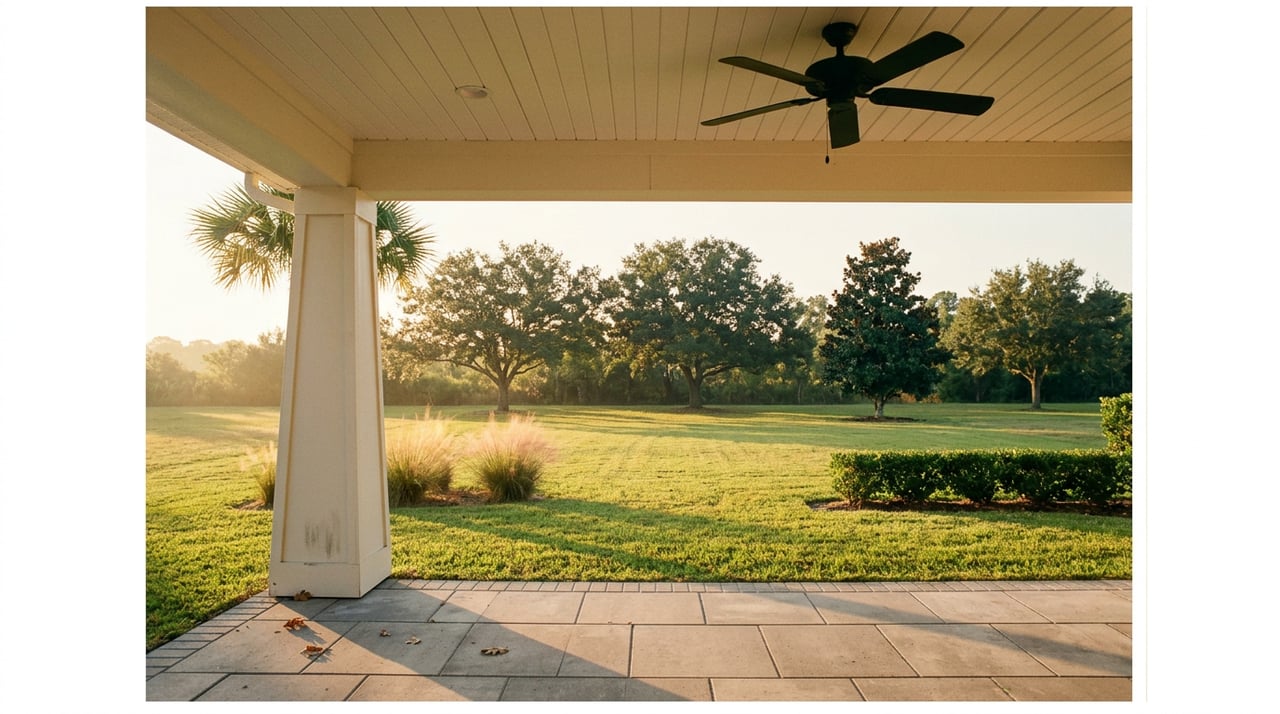
In Myrtle Beach, The Golf Course View Is A Lease, Not A Guarantee
August 27, 2026
August 27, 2026
"We were actually golfing on the course when we saw the house that we now live in."
— Myrtle Beach Golf and Yacht Club resident, quoted in WMBF News
That's how one Myrtle Beach Golf and Yacht Club resident described buying his home, back when Heron Point Golf Club was still an active course running through the middle of his neighborhood. He bought the lot because of the fairway behind it. A few years later, the fairway closed for good.
I hear some version of that story every year from buyers touring homes along the back nine of a Grand Strand community. The course is green, the greens fee board is posted at the clubhouse, and the listing agent calls it a premium lot. The course itself is a business, sitting on land that has its own separate set of economics, and that business can fail while the neighborhood around it keeps going.
Buyers treat a golf course view the way they'd treat an ocean view: as a permanent feature of the property. It isn't. An ocean doesn't need 300 rounds a week to stay where it is. A golf course does, and when it doesn't get them, the land underneath it becomes worth more as house lots than as turf.
That isn't a hunch. It's the exact pattern that's played out across Horry County for the better part of two decades, and it's playing out again right now, less than a year old, at a course a lot of Myrtle Beach buyers have driven past without a second thought.
A longtime marketer of the Myrtle Beach golf industry has put it plainly over the years: plenty of these courses went in as a way to sell home sites, with golf as the amenity that moved the lots. The lots around the fairways were the actual product. The golf was what made people want to stand on them. As long as green fees and memberships covered maintenance, that arrangement worked in both directions. When they stopped covering it, the arrangement stopped making sense for whoever owned the dirt.
Over the past several years, that math has closed a run of Grand Strand courses: The Witch Golf Links, Farmstead Golf Links, Possum Trot Golf Club, Heather Glen Golf Links, and Indian Wells Golf Club have all shut down entirely, with partial nine-hole closures at Aberdeen Country Club and The Pearl Golf Links on top of that. Cypress Bay Golf Club in Little River closed and sold to Mungo Homes for redevelopment. Mungo is the same builder now putting up 220 houses on the Bear nine at River Oaks. This is not a builder discovering a new opportunity. It's a builder repeating a playbook.
River Oaks Golf Club closed for good on November 30, 2025, after 38 years of operation, following a one-month extension from its original October 31 closing date. Longtime general manager Scott Taylor had run the course since 2009 and spent its final season swapping in new UltraDwarf Bermudagrass on four greens even as the closing date approached.
The land didn't wait for sentiment to catch up. Developer Chris Manning bought the Bear nine back in 2021 for $3 million, then sold it to Mungo Homes for $9.5 million, which is now building roughly 220 houses on it. Manning came back in February 2024 and bought the remaining Fox and Otter nines, 172 acres, for $9.2 million, with plans for 370 more lots. Add it up and River Oaks becomes close to 600 new homes, and River Oaks Drive itself is slated to widen from a two-lane road to four lanes to handle the traffic that comes with it.
What's worth sitting with here isn't the closure itself. It's the timeline. A course can remain a working, revenue-generating business until its land is sold, and a closing date may be scheduled around permits.
If River Oaks shows how fast this can move once the land sale happens, Heron Point shows the other outcome, the one that doesn't resolve neatly.
Heron Point Golf Club closed on December 14, 2014, at the center of what's known today as the Myrtle Beach Golf and Yacht Club, a gated community of neighborhoods including Camelot, Ashley Cove, The Gardens, and The Fairways. According to Club & Resort Business, the course's majority partner at the time said: "I don't think it would ever be profitable, not in this market." Residents worried openly at the time about what would happen to their property values, and about the fairway going overgrown behind their homes.
More than a decade later, no housing development has replaced it, and there's been no announced plan to reopen it as a course either. The land has essentially sat in limbo. And the neighborhood has kept functioning anyway. Homes in Myrtle Beach Golf and Yacht still sell today, from older two and three bedroom homes in the $150,000s up to newer four and five bedroom homes near $300,000, inside a gated community with full-time security. The course closed. The community didn't.
That's the part most golf-course closure conversations skip. River Oaks is heading toward fast, dense redevelopment because a developer already owned the land and had permits moving. Heron Point shows the quieter, more common version: the course closes, the land sits, and the "view" becomes an overgrown former fairway with no clear timeline for what comes next. Both are real outcomes. Neither is the same as the course simply staying a course.
None of this means avoid golf-adjacent homes in Myrtle Beach. It means the diligence needs to shift from "is this a nice course" to "what happens to this land if the course stops being one." A few things I walk buyers through before they write an offer on a golf-course lot:
By mid-August 2026, homes across the greater Myrtle Beach market were listing at a median of roughly $489,900, and golf-course-adjacent homes sit inside that broader number rather than as a category all their own. That means the golf view isn't showing up as a clean, separate line item on paper. It's baked into a price you're already comparing against everything else, which is exactly why it's worth asking the questions above before you decide what part of that price you're actually paying for.
Does living near a closed golf course lower home values in Myrtle Beach? It depends heavily on what replaces the course, or whether anything does. Heron Point's surrounding community has continued to sell homes for over a decade with no course at all, while a closure that quickly converts to a few hundred new houses, like River Oaks, changes the character and traffic of the area in a very different way than land that simply sits.
Is a currently active golf course a safer purchase than one that's already closed? Not automatically. Ownership structure and the course's underlying economics matter more than how the fairways look this season. A course can be well maintained and still be sold out from under its golfers with little warning.
How would I even find out if a course's land has recently changed hands? It shows up in county land records well before any public announcement, which is one of the reasons I encourage buyers to ask their agent to check ownership history on the parcel itself, not just pull up the listing.
If you're weighing a home near one of the Grand Strand's remaining golf courses, or trying to make sense of what a listing price is really telling you once you look past the median, I'd rather walk through the specifics with you directly than have you guess. Michelle Schneider — Let's Connect.
This article is general information, not legal, tax or financial advice. Consult a qualified professional about your situation.
Stay up to date on the latest real estate trends.
With a foundation rooted in multi-generational real estate investment, I bring practical experience in residential and commercial properties, renovations, and client service.
Michelle Schneider
35 Capers Way Pawleys Island SC 29585