In Murrells Inlet, The Dock Decides The Deal, Not The Median Price
August 13, 2026
August 13, 2026
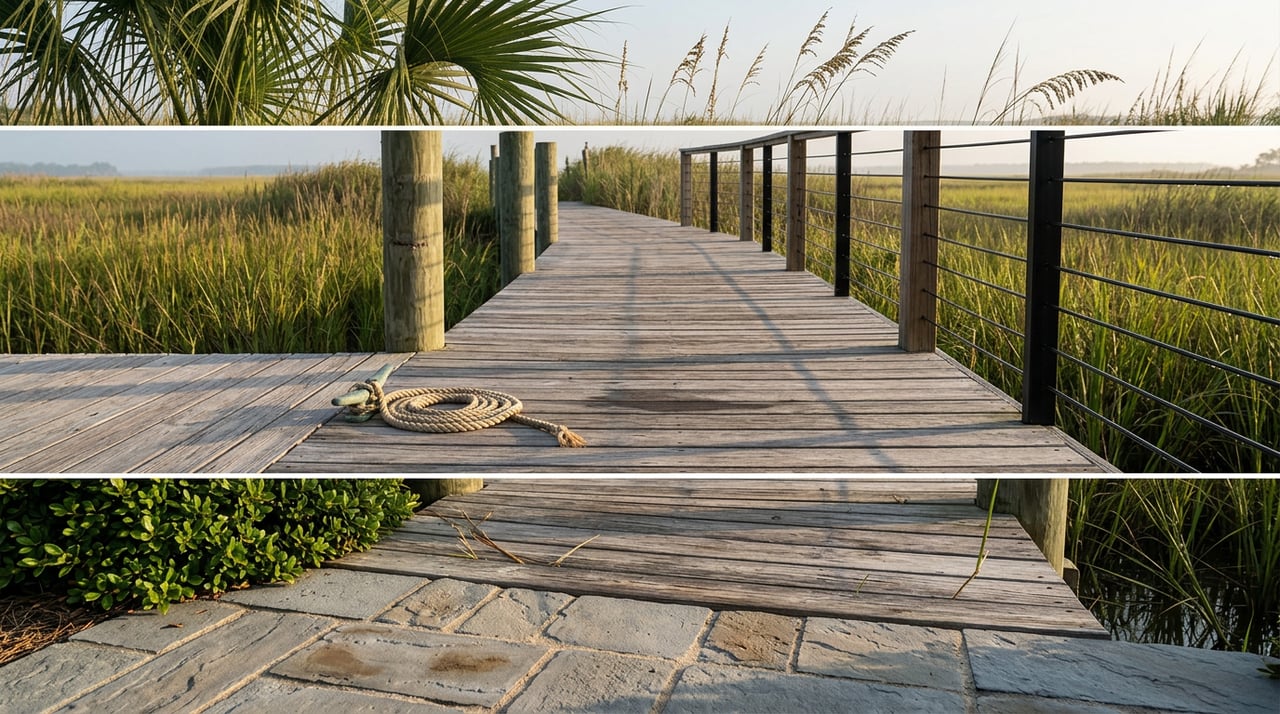
The first thing my buyer noticed wasn't the house. It was the give underfoot on the dock behind it, a slight softness in the third board past the ramp on a property off Creek Shore Drive. She was there for the marsh view. I was already thinking about who built that dock, how old it was, and whether the seller had a permit on file anywhere. That thirty-second walk told me more about what we were actually negotiating than the listing sheet did.
That is the pattern here. On the water in Murrells Inlet, the house is often the easier appraisal. The dock, and everything that comes with it, is where a deal gets complicated or falls apart. If you're buying or selling waterfront property in this town, the median price you saw on a portal is close to useless for this specific question. The dock is where the real information lives.
Ask five different market trackers for the current median price in Murrells Inlet and you'll get five different answers, sometimes in the same season. In February 2026, one local snapshot put the median sold price at $390,000, with active listings carrying a median list price of $394,950. But the homes actually going under contract that month were agreeing to a median of $367,450, noticeably below either headline number. By April 2026, another tracker had the sale-to-list ratio sitting just above 98 percent, with only about 8 percent of homes selling above asking. A separate read in May 2026 put the median price for a single-family home at $410,000.
None of these figures are wrong. They're measuring different slices of the same messy pie: active versus pending versus closed, single-family versus all residential types, one zip code's worth of golf villas blended with marsh cottages and inlet condos. A town-wide median can't tell you what a specific creek-front parcel is worth, because it's averaging properties that aren't comparable assets in the first place. A home with a legal, permitted dock and a home with a water view and no path to ever building one get counted the same way in that number. They should not sell the same way.
The variable that actually separates those two homes is written into state coastal regulation, not into any listing description. South Carolina's Department of Environmental Services, through its Bureau of Coastal Management, still gets called DHEC-OCRM by a lot of longtime agents and inspectors around here out of habit, measures every creek from marsh grass to marsh grass before it will consider a new dock permit. The rule is specific: on a creek under 20 feet wide, no new dock is allowed at all unless the property has at least 500 feet of water frontage, or there's genuinely no potential dock site on the opposite bank. On those same narrow creeks, boat lifts, davits, and boat storage docks are prohibited outright, no matter how much frontage you have.
If the parcel sits inside an established subdivision, there may already be an approved Dock Master Plan on file that spells out which lots are even eligible. That's worth asking for early, because SCDES is direct about the limits of that document: a Dock Master Plan is a guide, not a guarantee that any specific lot will get a permit. I've had clients fall for a marsh view before confirming any of this. A beautiful view of open water doesn't tell you whether the creek in front of it is wide enough, or whether the lot has the frontage to qualify for an exception if it isn't.
Even on a creek that clears the 20-foot threshold, the structure itself is capped. Under current SCDES minor activity permitting rules, a private dock's platform, not counting the walkway, ramps, or mooring piles, tops out at 50 square feet unless the site qualifies for one of the case-by-case exceptions the agency allows. The application itself carries a non-refundable fee, $250 for most minor activities or $150 if the walkway runs under 100 feet, and the process requires notifying every adjoining property owner in writing so they can weigh in through a public notice.
That last part matters more than it sounds. SCDES actively encourages joint-use docks between neighbors specifically to cut down on the number of structures crowding a single creek. If you're buying into a property with an existing shared dock, get the maintenance and cost-sharing agreement in writing before closing, not after the first storm damages a piling.
Assuming the permit and the creek width both check out, the next question is what the dock is actually made of and how long it's been in the water. A marine contractor based right here in Murrells Inlet, Myrtle Beach Elite Dock Building, describes this stretch of the Grand Strand as the most active dock-building market on the coast, precisely because the tidal creek system is so extensive and the salt exposure so relentless. Along Creek Shore Drive and around Inlet Harbour, they've replaced pressure-treated pine docks that were only ten to twelve years old, because standard lumber simply doesn't hold up to the tidal swing and salt air the way people expect. Composite decking and marine-grade aluminum last longer, but they cost more up front.
For a buyer, that means asking a seller's dock age the same way you'd ask a roof's age. For a seller, it means knowing whether your ten-year-old wood dock is an asset or a line item the next buyer's inspector is going to flag.
There's a second layer to this that most buyers never hear about until they've already made an offer: the inlet itself is in the middle of a multi-year navigability project, and it isn't reaching every creek on the same timeline.
Georgetown County began planning it in 2019 and applied to the Army Corps of Engineers in 2023 for a permit to remove roughly 750,000 cubic yards of accumulated sediment, with the material disposed of at a nearshore site off Huntington Beach State Park. The full project is estimated at about $35 million, with an initial $10 million earmarked to start with the Main Creek corridor along South Waccamaw Drive in Garden City and its related tributaries. County planning documents lay out the rest of the work in phases by specific creek:
| Phase | Creeks and areas included |
|---|---|
| First funded phase | Main Creek, South Waccamaw area of Garden City and related tributaries |
| Later phase | Marina Colony, Flagg Point Canal, Mt. Gilead Canal, Inlet Harbor, Marlin Quay Marina |
| Later phase | Parsonage Creek, Allston Creek, Oaks Creek, and adjoining creek segments |
Coastal Observer's reporting from November 2023 put the construction window at three years, starting in the fall of 2025. But the picture is uneven, not uniform. In February 2026 reporting on the project, county officials confirmed the jetty weir designed to trap migrating sand at the inlet's entrance isn't functioning as intended, and a proposed pair of groins to help the Inlet Harbour area, backed by $2 million in county capital funds, remains an unfunded contingency with no guarantee it ever gets built. Meanwhile a separate federal beach renourishment project already reaches a little over a mile of Garden City shoreline as part of work that started further north.
None of this means "Murrells Inlet is getting dredged" as a blanket upgrade to every dock owner's boat access. It means a specific creek, named on a county engineering map, is scheduled to get deeper water first, while a property a few hundred yards away on a different tributary may be waiting years longer, or waiting on funding that isn't secured yet. If you're evaluating a waterfront home for its boating access, the honest question isn't whether the inlet is being dredged. It's whether your specific creek is in the current funded phase.
For buyers, the due diligence list on a Murrells Inlet waterfront property should include the dock permit itself, confirmation of any approved Dock Master Plan for the subdivision, a measurement or survey note on creek width and frontage, the dock's age and construction material, and, if it's shared, the written maintenance agreement. Budget for the ongoing costs too. Dock or slip fees in this market commonly run from a few hundred dollars to $1,000 or more a month depending on boat size and location, and flood insurance on a waterfront parcel often adds $1,000 or more a year beyond a standard homeowner policy.
For sellers, the smartest move is getting ahead of these same questions before a buyer's inspector raises them. If your dock permit is in a file somewhere, pull it now. If your dock is pressure-treated pine and past its tenth birthday, know your realistic replacement cost before you set a list price, not after a buyer's inspection report lands on the table.
Can I put a boat lift on my dock in Murrells Inlet? Only if the creek fronting your property measures at least 20 feet wide. On narrower creeks, boat lifts, davits, and boat storage docks are prohibited outright under current SCDES rules, regardless of how much frontage the lot has.
What if my creek is narrow and I don't have 500 feet of frontage? Then a new private dock likely won't be permitted at all, unless there's genuinely no potential dock site across the creek. This is exactly the scenario where a gorgeous marsh view doesn't equal buildable water access, and it's worth confirming before you fall for it.
Can I share a dock with a neighbor instead? Often, yes. SCDES actively encourages joint-use docks to reduce the number of structures on a single creek. You'll need your neighbor's cooperation and a clear written agreement on maintenance responsibility and shared use before it's a workable solution.
I grew up around rental properties and renovation projects long before I held a real estate license, which is probably why I ask about the dock file and the creek width before I ask about square footage. If you're buying or selling on the water anywhere between Garden City and the MarshWalk, Michelle Schneider would like to walk the dock with you first. Let's Connect.
Stay up to date on the latest real estate trends.

With a foundation rooted in multi-generational real estate investment, I bring practical experience in residential and commercial properties, renovations, and client service.
Michelle Schneider
35 Capers Way Pawleys Island SC 29585